The information on this website is general in nature and does not take into account your objectives, financial situation, or needs. Consider seeking personal advice from a licensed adviser before acting on any information.
Farm insurance claims in Australia usually involve making the property safe, notifying the insurer, documenting the loss, working through assessment and responding to any settlement offer. This guide explains the general process and what farmers can prepare before and after an insured event.
Understanding how farm insurance claims work in Australia can help farmers respond more calmly after damage, theft, loss or liability incidents. The exact farm insurance claim process depends on your policy, insurer, excess, exclusions, insured event and the evidence available, but most claims follow a similar path.
This guide explains the usual steps involved, what documentation may help, how assessments and settlements are commonly handled, and what to do if you disagree with an outcome. It is general information only and does not replace advice from your insurer, broker, legal adviser or other qualified professional.
Before anything else: safety and loss prevention
After a fire, storm, flood, machinery accident, livestock incident or other insured event, the first priority is safety. Do not enter damaged buildings, handle unsafe equipment, move unstable structures or approach injured animals if doing so could put people at risk.
Once it is safe, most policies expect policyholders to take reasonable steps to prevent further loss. This might include moving undamaged equipment under cover, arranging temporary fencing, covering exposed areas, isolating damaged machinery, securing a broken gate or arranging emergency veterinary attention for insured livestock.
Keep receipts and records for reasonable emergency expenses. Whether those costs are reimbursed depends on the wording of your policy and your insurer's assessment, so notify the insurer as soon as practical before committing to major repairs or replacement costs.
Step 1: Check the policy and identify the type of claim
Farm insurance policies can combine several types of cover, such as farm buildings, contents, machinery, livestock, crops, fencing, liability, business interruption or other optional extensions. Before lodging a claim, identify which part of the policy may apply.
Useful items to check include:
- The insured event: for example, fire, storm, theft, accidental damage, machinery breakdown or public liability.
- Policy limits: the maximum amount the insurer may pay for a covered item or event.
- Excess: the amount you may need to contribute if the claim is accepted.
- Exclusions: events, causes or circumstances the policy does not cover.
- Conditions: obligations such as maintenance, security, record keeping, notification or evidence requirements.
- Basis of settlement: whether cover is based on replacement, market value, agreed value, indemnity value or another method.
If policy wording is unclear, it may help to review common terms in A Farmer's Guide to Essential Farm Insurance Terminology before speaking with your insurer or broker.
Step 2: Notify your insurer or broker promptly
Most insurers ask policyholders to report potential claims as soon as reasonably possible. Prompt notification allows the insurer to explain next steps, arrange assessment if needed and tell you what evidence to preserve.
When making first contact, be ready to provide:
- your policy number or identifying details;
- the date, time and location of the incident, if known;
- a brief description of what happened;
- the assets, livestock, crops, buildings or third parties affected;
- any urgent safety or mitigation steps already taken;
- whether emergency services, police, vets, contractors or other professionals have been involved.
If you arranged your cover through an intermediary, a specialist may help with communication and claims administration. You can learn more about the role of insurance intermediaries on the Brokers page. Broker involvement does not guarantee that a claim will be accepted or paid in a particular way; the outcome still depends on the policy and insurer's assessment.
Step 3: Document the loss carefully
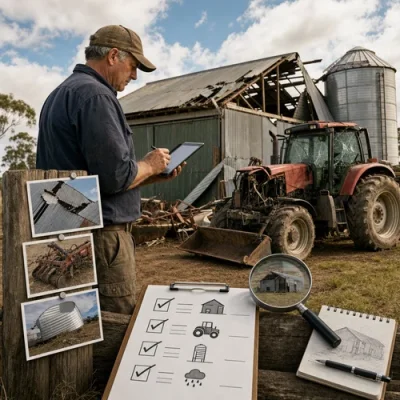
Strong documentation can make a farm damage insurance claim easier to assess. The type of evidence needed will vary, but the goal is to show what was damaged or lost, how it happened, the condition and value of the asset before the incident, and the cost of repair or replacement.
Evidence that may support a farm insurance claim
| Claim type | Examples of useful documentation |
|---|
| Buildings, fencing and fixed structures | Photos or videos of damage, maintenance records, building plans, repair quotes, invoices and evidence of ownership. |
| Machinery and equipment | Purchase invoices, serial numbers, service history, photos, inspection reports, repair assessments and replacement quotes. |
| Livestock | Livestock records, ear tag or NLIS details where relevant, veterinary reports, photos, sales records and mortality or injury evidence. |
| Crops or stored produce | Paddock records, planting details, yield history, photos, agronomist reports, storage records and evidence of the insured event. |
| Theft or malicious damage | Police report details, inventory lists, proof of ownership, photos, security records and witness information if available. |
| Liability incidents | Incident notes, names of involved parties, photos, correspondence, witness details and any legal or demand letters received. |
Take photos or videos before moving, repairing or disposing of damaged property, unless leaving it in place would create further risk. If disposal is necessary for safety, animal welfare or biosecurity reasons, keep clear records of why action was required.
Step 4: Avoid admitting liability or making unsupported commitments
If another person is injured or another person's property is damaged, be careful about what you say. You can provide practical assistance and record details without admitting fault or promising compensation.
For liability-related claims, contact your insurer before responding to a formal demand, solicitor's letter or compensation request. Many liability policies require the insurer to manage or approve the response. Acting without insurer approval may affect the claim, depending on the policy wording and circumstances.
Step 5: Work through the assessment process
After lodgement, the insurer may appoint an assessor, loss adjuster, investigator, engineer, builder, machinery specialist, agronomist, veterinarian or other professional depending on the claim. For smaller claims, the insurer may assess the matter using photos, invoices and quotes. For larger or more complex claims, a site visit may be required.
The assessor's role is generally to understand the cause and extent of the loss, estimate repair or replacement costs, and check whether the claim fits within the policy. They may ask for additional documents, interview people involved or request specialist reports.
During this stage, keep notes of conversations, including dates, names and agreed actions. If you send documents, keep copies. If you do not understand a request, ask why the information is needed and whether there is a deadline for providing it.
Step 6: Repairs, replacement and quotes
Your insurer may ask for repair quotes or may use its own repair network. For farm assets, local availability can matter, especially where specialised machinery, rural contractors or seasonal pressures are involved.
Before authorising non-urgent repairs, check whether the insurer needs to inspect the damage first. Emergency repairs to prevent further loss may be treated differently from permanent repairs, but this depends on the policy and insurer instructions.
Where replacement is involved, the settlement may depend on the asset's insured value, age, condition, depreciation, policy limit and basis of settlement. For example, a machinery claim may be treated differently under market value cover compared with replacement cover. A crop or livestock claim may require records that support quantity, quality, health, market value or production impact.
Step 7: Claim decision and settlement offer
Once the insurer has assessed the claim, it will usually decide whether the claim is accepted, partly accepted or declined. If accepted, settlement may take the form of a cash payment, repair approval, replacement arrangement, reimbursement or another method allowed by the policy.
The insurer may deduct an excess. It may also apply policy limits, sub-limits, depreciation, underinsurance clauses or exclusions where relevant. If the settlement differs from what you expected, ask for a written explanation that identifies the policy wording relied on and how the amount was calculated.
Farm insurance coverage can vary significantly between providers and policy types. If you are reviewing your cover after a claim or near renewal, the Farm Insurance Australia homepage provides a starting point for understanding farm insurance policies and quote considerations for Australian farms.
Common reasons farm insurance claims become complicated
Some claims are straightforward. Others take longer because the cause, cover, value or responsibility is unclear. Common complications include:
- Unclear cause of damage: for example, where poor maintenance and an insured weather event both contributed to the loss.
- Underinsurance: where insured values do not reflect the actual cost of repair, replacement or rebuilding.
- Missing records: especially for machinery value, livestock numbers, crop production, stored produce or maintenance.
- Policy exclusions: such as wear and tear, gradual deterioration, pre-existing damage or excluded weather events.
- Late notification: where delay makes it harder to verify the cause or extent of damage.
- Unauthorised repairs: where permanent repairs are completed before the insurer can inspect the damage.
- Seasonal urgency: where harvest, shearing, calving, sowing or irrigation timing creates pressure to restore operations quickly.
These issues do not automatically mean a claim will fail, but they can affect how it is assessed. Clear communication and evidence are important.
What if the claim is declined or you disagree with the settlement?
If you disagree with a claim decision, start by asking the insurer to explain the decision in writing. Check the relevant policy clauses, exclusions and calculations. If you think information has been misunderstood, provide further evidence and ask for the claim to be reviewed.
Most insurers have an internal complaints or dispute resolution process. If the matter is not resolved through the insurer's process, you may be able to take the complaint to the Australian Financial Complaints Authority, depending on the type of policy, parties involved and eligibility rules. You may also wish to obtain independent legal, accounting or insurance advice for complex or high-value disputes.
How to prepare before a claim happens
The easiest time to improve claim readiness is before a loss occurs. Good records, accurate valuations and regular policy reviews can reduce confusion later.
Practical preparation steps include:
- keep an up-to-date asset register for machinery, vehicles, tools, irrigation systems and farm contents;
- record serial numbers, purchase dates, invoices and photos of key assets;
- maintain livestock, crop, chemical, fertiliser and production records where relevant;
- review insured values after buying new equipment, expanding operations or improving buildings;
- keep maintenance records for buildings, fences, electrical systems, pumps and machinery;
- store digital backups of important documents away from the farm office;
- understand excesses, limits, exclusions and notification requirements before an incident occurs;
- ask your insurer or broker how claims should be lodged after-hours or during widespread disasters.
Questions to ask during the farm insurance claim process
When you lodge or manage a claim, asking clear questions can help you understand what happens next. Consider asking:
- What documents do you need from me?
- Should I wait for inspection before arranging repairs?
- Are emergency repairs or mitigation costs handled separately?
- Will an assessor or loss adjuster visit the farm?
- How will the value of the damaged asset be calculated?
- Which excess, limit or sub-limit may apply?
- What policy exclusions or conditions are being considered?
- How will you communicate updates, and who is my main contact?
- What can I do if I disagree with the outcome?
Final thoughts
Making a farm insurance claim in Australia usually involves prompt notification, careful documentation, insurer assessment and a settlement decision based on the policy. The process can feel demanding, especially when farm operations are disrupted, but preparation can make a significant difference.
Keep good records, understand your policy before an incident, communicate early and avoid making assumptions about cover. Claim outcomes depend on individual circumstances, policy wording and insurer criteria, so ask questions and seek appropriate support if the claim is complex or disputed.
Published: Saturday, 8th Aug 2026
Author: Paige Estritori








No comments yet. Be the first to share your thoughts.