The information on this website is general in nature and does not take into account your objectives, financial situation, or needs. Consider seeking personal advice from a licensed adviser before acting on any information.
Farm business interruption insurance can help commercial farm operators think about income disruption, extra operating costs and recovery time after an insured event. This guide explains how the cover generally works, what farms should review in policy wording and what records may support a claim.
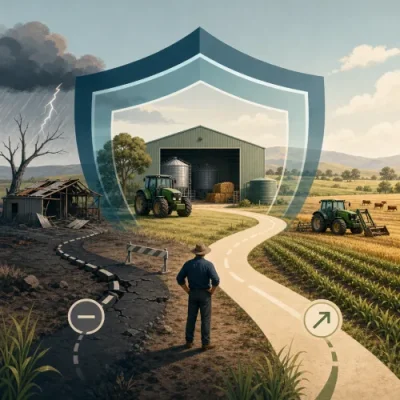
Farm business interruption insurance is designed to address a different problem from damaged sheds, machinery or stock. Property cover may help repair or replace insured assets after an event, while business interruption cover looks at the financial effect on the farm business when normal operations are disrupted.
For Australian commercial farms and larger mixed-enterprise operations, this can be an important but sometimes misunderstood part of commercial farm insurance. The right approach depends on the farm’s activities, revenue cycle, policy wording, insured events, waiting periods, limits and the way income and expenses are recorded.
What is farm business interruption insurance?
Farm business interruption insurance is a form of income-related cover that may respond when an insured event interrupts the operation of a farm business. It is generally intended to help with the financial consequences of interruption, rather than the physical repair of damaged property itself.
Depending on the policy, cover may relate to matters such as:
- loss of gross profit or farm income after an insured event;
- ongoing fixed costs that still need to be paid while the farm is disrupted;
- extra costs reasonably incurred to keep the business operating or reduce the loss;
- temporary relocation, outsourcing or alternative arrangements where covered;
- delays in returning to normal trading after repairs or replacement.
The exact scope varies significantly between insurers and policy types. Farmers should read the Product Disclosure Statement, policy schedule and any endorsements carefully, and consider professional assistance where the wording is complex.
How business interruption differs from property damage cover
A common mistake is assuming that property insurance automatically covers lost income. In many policies, property damage and business interruption are separate sections with different triggers, limits and claim calculations.
| Cover type |
Main focus |
Farm example |
| Property, machinery or equipment cover |
Repairing or replacing insured physical assets after an insured event |
A fire damages a packing shed, irrigation pump or stored equipment |
| Farm business interruption insurance |
Financial impact of the interruption to business operations |
The damaged packing shed delays harvest handling, sales or production, affecting revenue and creating extra operating costs |
In many cases, business interruption cover is linked to insured physical damage. If the event that caused the interruption is excluded under the property section, the income-related claim may also be limited or unavailable. This is why the trigger wording matters.
Events that may cause farm revenue disruption
Farm revenue disruption can arise in many ways, but business interruption cover usually only responds to events insured by the policy. These may include certain forms of fire, storm, accidental damage, theft or other listed events, depending on the wording.
Examples of interruption scenarios a commercial farm may need to think about include:
- a fire or storm damaging a dairy, packing facility, cool room, workshop or storage shed;
- damage to key machinery at a critical point in the season;
- loss of power or access where the policy includes relevant extensions;
- damage to grain, produce or inputs that affects production or sales;
- damage to irrigation infrastructure, fencing or other operational assets;
- interruption to processing, storage, transport or on-farm retail activities.
Some events that affect farm income may not be covered, or may require specific cover. Drought, gradual deterioration, commodity price changes, disease outbreaks, biosecurity events, supplier disruption and market access issues are not automatically covered under standard business interruption wording. They need to be checked against the policy.
What can agricultural business interruption cover include?
Agricultural business interruption cover is not identical across policies. The following elements are common areas to review when comparing or renewing cover.
Loss of gross profit or income
Some policies focus on loss of gross profit, while others may refer to revenue, turnover or income. The calculation can be technical. It may involve comparing expected trading results with actual results during the interruption period, then adjusting for saved expenses and other factors.
For farms with seasonal production, long growing cycles or livestock breeding programs, this calculation can be more complicated than for a business with steady weekly sales. Policyholders should consider whether the insured amount reflects the financial structure of the enterprise, not just last year’s figures.
Increased cost of working insurance
Increased cost of working insurance may cover extra expenses incurred to reduce the interruption loss, where those expenses are covered and reasonable under the policy. For a farm, this might include temporary equipment hire, alternative storage, contracting part of the work to another operator, freight changes or short-term arrangements to maintain production.
This cover is not a blank cheque for any extra cost. Policies usually require the cost to be connected to the insured event and incurred to avoid or reduce a covered loss. Approval, evidence and limits may apply.
Ongoing expenses
Even when production stops or slows, many expenses continue. These may include wages, finance commitments, rates, leases, utilities, maintenance contracts and other fixed costs. Whether these are covered depends on the policy structure and claim calculation.
Claims preparation costs
Some policies include limited cover for professional costs involved in preparing or proving a business interruption claim. These may include accountant or adviser costs, but only if the policy allows them and any limits or conditions are met.
Why farm business interruption insurance can be complex
Farm businesses often have features that make interruption cover more difficult to set than a simple retail or office-based business policy.
- Seasonality: Income may depend on harvest, shearing, breeding, calving, sales contracts or export windows.
- Mixed enterprises: A farm may combine crops, livestock, contracting, agistment, processing, accommodation or direct-to-consumer sales.
- Long recovery periods: Rebuilding sheds, replacing specialised equipment or restoring production capacity can take time.
- Dependent assets: One damaged asset can affect several income streams, such as irrigation pumps, storage, milking systems or packing lines.
- Variable costs: Some expenses fall when production stops, while others continue or increase.
- External dependencies: Access roads, power, suppliers, buyers and processors may affect recovery, but may only be covered if the policy includes relevant extensions.
These factors make it important to set insured amounts and interruption periods based on the actual operating model of the farm, rather than using a generic estimate.
Key policy terms farmers should review
Before choosing or renewing business interruption cover, farmers should review the policy wording and schedule carefully. If the terms are unclear, a specialist insurance broker or adviser may help explain how the wording is intended to operate. You can also review general farm insurance document concepts in this guide to farm insurance terms, policy documents and disclosure obligations.
Insured events and triggers
Check what must happen before business interruption cover can respond. Many policies require insured physical damage to property used by the business. Some may include extensions for prevention of access, utility interruption, damage at customer or supplier premises, or other dependency risks, but these are not universal.
Indemnity period
The indemnity period is the maximum period for which the policy may pay for covered interruption losses. A farm may need more time to recover than the physical repair period, especially if the event affects a seasonal production window or specialised facilities.
For example, if damage occurs shortly before harvest or during a key breeding period, the financial consequences may extend beyond the date repairs are completed. The selected indemnity period should reflect realistic recovery time, subject to policy options and insurer criteria.
Waiting period or time excess
Some business interruption policies apply a waiting period before cover starts. This may be expressed in hours, days or another measure, depending on the policy. A short disruption may therefore fall outside the cover or be reduced by the waiting period.
Sum insured and sub-limits
The business interruption sum insured should be reviewed against expected income, gross profit, fixed expenses and recovery scenarios. Extensions may also have sub-limits, which can be lower than the main cover limit.
Exclusions and conditions
Exclusions can significantly affect business interruption claims. Farmers should check exclusions for uninsured perils, disease, contamination, market conditions, voluntary shutdowns, underinsurance, poor maintenance, delayed notification and other policy conditions.
Records that may support a business interruption claim
Good records are important before and after an insured event. A business interruption claim often requires evidence of what the farm would likely have earned, what it actually earned, what expenses continued and what extra costs were incurred.
Useful records may include:
- profit and loss statements, balance sheets and tax records;
- production records, yield records, livestock records and inventory reports;
- sales contracts, delivery records, invoices and purchase orders;
- seasonal budgets and cash flow forecasts;
- machinery, storage and infrastructure maintenance records;
- photos, incident notes and damage reports;
- quotes, invoices and receipts for temporary arrangements or repairs;
- correspondence with buyers, suppliers, contractors and processors;
- evidence of saved costs, such as reduced inputs or variable labour.
The records needed will depend on the farm business and the policy. Keeping financial and production records current can make it easier to explain the loss if a claim occurs.
How a farm business interruption claim may be assessed
The claims process will vary, but a business interruption claim often involves both the insured event and the financial impact. Farmers may need to show that the interruption was caused by an event covered by the policy and that the amount claimed is supported by records.
A typical process may include:
- making the property safe and taking reasonable steps to prevent further loss;
- notifying the insurer or broker promptly;
- identifying the relevant policy sections and interruption cover;
- documenting the physical damage and operational disruption;
- tracking lost sales, delayed production and extra costs;
- working with assessors, loss adjusters, accountants or advisers if required;
- responding to information requests and reviewing any settlement calculation.
For broader claims preparation guidance, see our article on how farm insurance claims work in Australia.
Questions to ask before reviewing this type of cover
When reviewing farm business interruption insurance, the following questions can help focus the discussion:
- Which insured events can trigger business interruption cover?
- Does cover require physical damage to insured property?
- Are seasonal income patterns, crop cycles or livestock cycles properly reflected?
- Is the indemnity period long enough for realistic recovery?
- How would loss of gross profit, revenue or income be calculated?
- What increased cost of working expenses may be covered?
- Are there extensions for utility failure, prevention of access, suppliers or customers?
- What waiting periods, excesses, sub-limits and exclusions apply?
- What financial and production records would be needed for a claim?
- How does the cover interact with machinery, crop, livestock and property insurance?
When to review business interruption cover
Business interruption cover should not be set once and forgotten. A review may be useful when the farm changes its enterprise mix, expands operations, adds processing or storage facilities, takes on major contracts, upgrades irrigation, changes machinery dependency, increases livestock numbers or starts new revenue activities.
Reviews are also useful after major weather events, claims, property improvements, changes to finance arrangements or shifts in supply chain reliance. The aim is to keep the cover aligned with the way the farm actually earns income and recovers from disruption.
Getting help with farm insurance quote enquiries
Business interruption wording can be technical, particularly for mixed-enterprise and commercial farming operations. If you are comparing policy options or preparing for renewal, it may be worth discussing the farm’s income streams, fixed costs, seasonal risks and recovery assumptions with an insurance professional.
Farm Insurance Australia provides general information and a way to make farm insurance quote enquiries through participating providers. Any cover, pricing and acceptance will depend on the farm’s circumstances, insurer criteria and the policy terms offered.
Final thoughts
Farm business interruption insurance is about the financial impact of disruption, not just the damaged asset that caused it. For commercial farms, the key issues are the insured trigger, the way income loss is calculated, the indemnity period, increased cost of working cover, exclusions and the quality of supporting records.
Because every farm has a different income cycle and risk profile, farmers should treat business interruption cover as a detailed review item rather than a simple add-on. Understanding the policy wording before an event occurs can make a significant difference to how confidently the farm can respond after disruption.
Published: Thursday, 26th Nov 2026
Author: Paige Estritori




No comments yet. Be the first to share your thoughts.